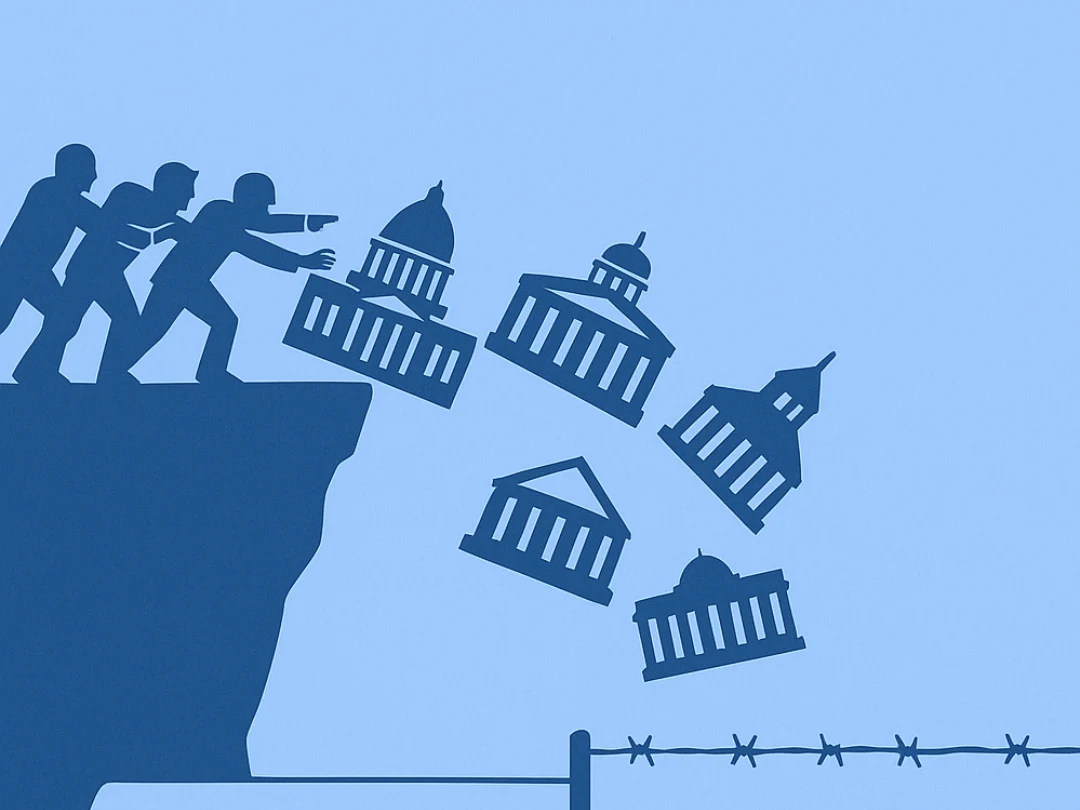
When democracies fall, it often happens dramatically—coup d’états, uprisings, military intervention. But that is the visible fall. The invisible decay begins long before.
Most democratic collapses follow patterns so well documented in history that political science no longer treats them as random. Polybius described them in antiquity. Aristotle categorized them. According to ChatGPT, modern scholars such as Joseph Tainter, Mancur Olson, Francis Fukuyama, and Daron Acemoglu have further developed the same phases:
prosperity → complexity → distorted representation → weakened oversight → economic misallocation → middle-class impoverishment → trust collapse → regime change.
The fall of democracies historically foretold
This does not make today’s assessment of democracy a prophecy, but a sober historical parallel. Phases that have brought down democracies in the past—republics, city-states, modern states—are once again beginning to materialize in the present.
Read also: Oversight committees are politicians controlling other politicians. A poor principle in a democracy?
Several modern democracies are already well into this pattern: the United States, France, the United Kingdom, New Zealand, and Canada.
In Norway, the pain is less visible than elsewhere, but not because the democratic system is strong—it is because of the oil fund. Both governance structures and the exercise of power display the same traits that historically have driven democracies into collapse. That it occurs subsidized by oil could potentially make a collapse even more brutal.
The eight phases below used by Oagal build on theories of social cycles and democratic erosion—see for example Social cycle theory and Democratic backsliding.
Phase 1: Prosperity grows—and the state grows with it
Democracies often begin their decline in times of prosperity. When the middle class is strong, incomes high, and inequality moderate, administrative structures steadily expand. This applies to Norway as well. The state grows, bureaucracy expands, and more jobs shift from productive sectors to public administration.
This feels stable—but history shows it is a fragile moment.
Phase 2: Citizen representation slowly erodes
As the state grows, citizen representation can gradually deteriorate. Norway has moved from one of the world’s most open electoral systems to a system in which voters no longer choose representatives, but parties. When closed lists are not supplemented by other personal-vote systems such as New Zealand’s Mixed Member Proportional, an organization-representative system of governance emerges, in which party organizations—not voters—become the real holders of power.
In Norway, Parliament pushed through the new electoral law in 2023, with only brief protests from a state-subsidized press. In connection with the 2025 parliamentary election, Oagal attempted to alert editors to the issue. The fact that the article on personal votes became the top story in the days before the election shows that citizens were searching for ways to cast personal votes and likely understood that they had been misled by the country’s foremost elected officials more than two years earlier.
This is how democracies are taken over in modern times—not through tanks, but through political decisions passed with resounding majorities to strip democracy of its core of directly elected representatives.
Read also: Concerned? Here is the Oagal model to strengthen Norwegian democracy
Phase 3: Oversight bodies move beyond the people’s reach
Another historical sign of democratic erosion is when oversight institutions—national audit offices, regulatory authorities, surveillance bodies, directorates—move further away from popular anchoring. They become technocratic, often politically steered, and in practice harder to hold accountable.
In Norway, much of the oversight of politics has been shifted to bodies not accountable to citizens. This ranges from small elites with aristocracy-like traits within party organizations to how state-supported media interpret their role.
When oversight itself cannot be overseen, democracy loses its safety valve.
Phase 4: Courts lose their constitutional force
In a functioning democracy, courts must intervene when politics collides with the constitution. Historically, judicial passivity is a recurring marker of democratic collapse.
In Norway, courts very rarely use their authority to stop legislation that weakens popular rule, representation, or constitutional principles. Do the courts fail to understand their constitutional role? Regardless, power shifts—not through unlawful acts, but through a lack of correction.
Phase 5: Redistribution becomes disconnection
All democracies redistribute. The problem arises when rhetorical fairness becomes systemic failure: what is presented as redistribution from the “rich” to the “poor” becomes, in practice, redistribution from the middle class to an ever-expanding political industry. In any population, most people are ordinary—including members of the middle class.
There is historical precedent. In antiquity, the middle class was the first group to lose economic viability under heavy burdens. This led to declining production, reduced innovation, and weakened societal capacity. Something similar is happening today:
- high taxes on labor
- pressure on families
- high housing costs
- businesses relocating abroad
- young people unable to gain a foothold
The development is structural. When politicians also spend resources too quickly and irresponsibly, this crucial group—historically a pillar of democracy—is drained.
Phase 6: The middle class is squeezed out—a critical point
The middle class is the backbone of democracy. When it is pressured sufficiently, democracy ceases to function. In several countries we see this:
- In the United States, purchasing power is eroding.
- In New Zealand, young and highly educated citizens are leaving.
- In Canada, living costs are pushing people out of the country.
- In France, society is marked by political instability.
When the middle class gives up—or leaves the country—democracy enters an irreversible phase. Norway is not there yet. The oil fund slows the process.
Phase 7: Polarization becomes the norm
When citizen representation weakens and the middle class is strained beyond capacity, polarization arises—not from right-wing or left-wing extremism, but from politician-driven political extremism. Voters lose trust and turn to parties promising quick solutions when major governing parties fail to represent the whole population. The people are not extreme—the system that has ceased to function is.
Phase 8: Institutional collapse—often without fanfare
Ultimately, democracy falls—not because the state is suddenly overthrown, but because:
- oversight mechanisms no longer function
- courts fail to correct
- representation has disappeared
- the middle class is weakened
- politicians and bureaucracy govern each other
Thus democracies collapse through administrative language, budget decisions, electoral-law changes, and party rule lacking the same trust in the people that the people place in them.
This is how these democracies fell
This is historically well-documented material (source: ChatGPT). All examples below are unambiguously documented and recognized in historical scholarship.
1. Athens – 5th century BCE
Phase that brought them down: Overextension, loss of middle-class economic strength, extreme taxation, and distrust.
What happened: Athens went from flourishing democracy to chaos after the Peloponnesian War. The middle class bore the burdens while elites directed war and taxation. The result: economic ruin, political polarization, and ultimately oligarchy.
2. The Roman Republic – 133–27 BCE
Phase that brought them down: Fragmentation of the middle class, concentration of power, bureaucratized patronage systems.
What happened: Land scarcity and taxation dissolved the middle class. Elites used state power for self-enrichment. The result was civil wars and the transition from republic to empire.
3. The late Roman Empire – 200–476 CE
Phase that brought them down: Complexity → stagnation → taxation → collapse (Tainter).
What happened: A heavily burdened middle class. State expenditures rose, productivity declined, taxes increased dramatically. People fled cities and labor. The state collapsed internally before external invasions delivered the final blow.
4. Venice – 1400s–1700s
Phase that brought them down: Formal democracy with real oligarchization.
What happened: The wealthiest families concentrated power and closed the system to ordinary citizens. The trade system became rigid and costly. The result was economic stagnation and loss of international relevance.
5. The Weimar Republic – 1920–1933
Phase that brought them down: Tax pressure, middle-class ruin, extreme polarization.
What happened: Hyperinflation and unemployment destroyed the middle class. A collapse of trust led citizens toward extremist parties. Democratic institutions were sidelined “legally.”
6. Argentina – 1946–present
Phase that brought them down: Populism and economic misallocation over decades.
What happened: Peronism drained state finances and weakened the middle class while the state expanded. The result was recurring crises and democratic erosion.
7. Venezuela – 1999–present
Phase that brought them down: Irresponsible redistribution, weakened rule of law, party dominance.
What happened: Oil revenues were used to buy political loyalty. Oversight institutions were politicized. The middle class was squeezed out. The state collapsed from within.
8. Greece – 2008–2015
Phase that brought them down: Extreme complexity, fiscal mismanagement, middle-class ruin.
What happened: Mismanagement of the economy and massive public spending led to external control of the state. The middle class was devastated and democracy weakened.
References on patterns of democratic decline
Polybius – Anacyclosis (cycle of regimes)
Aristotle – Politics (patterns of democratic decay)
Joseph Tainter – The Collapse of Complex Societies
Francis Fukuyama – Political Order and Political Decay
Mancur Olson – The Rise and Decline of Nations
Daron Acemoglu & James Robinson – Why Nations Fail
De fleste av artiklene på Oagal er utarbeidet av redaksjonen. Innholdet fra redaksjonen er det fortløpende redaksjonelle arbeidet i Oagal. Redaksjonen driver undersøkende journalistikk, utvikler ideer til saker og utarbeider artikler ved hjelp av ulike tilgjengelige kilder og verktøy. Meningsbærende innhold og også reportasjer bærer skribentens navn.


0 Comments