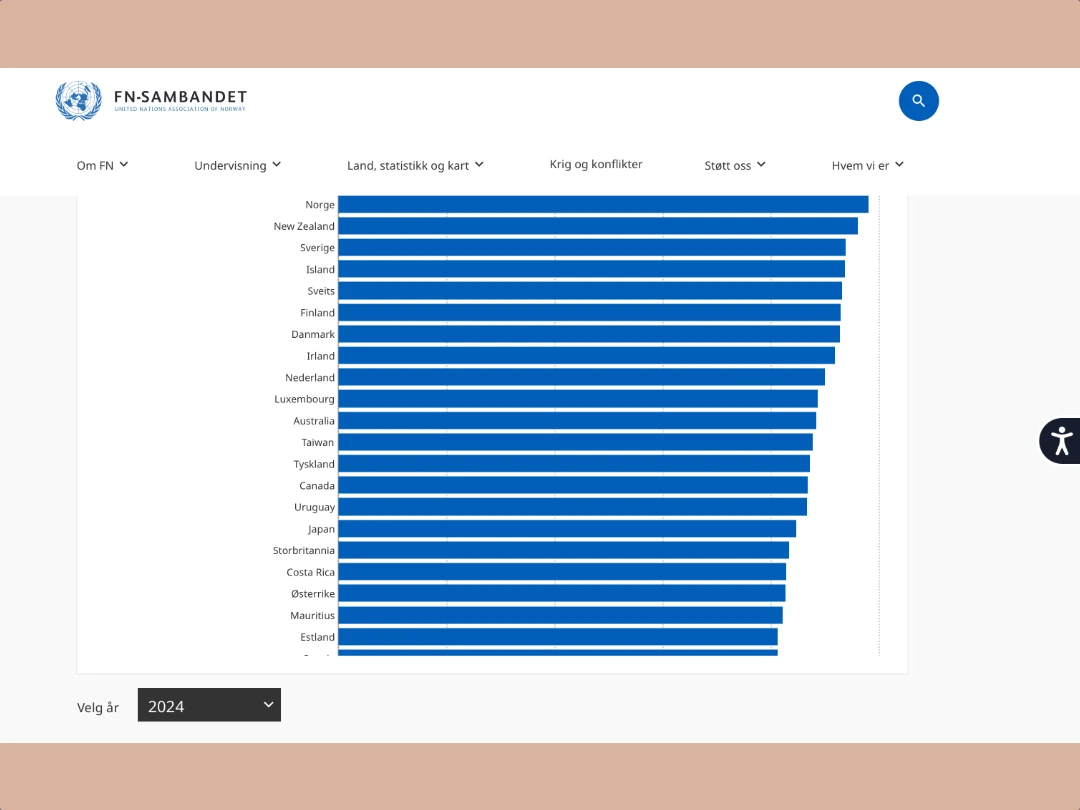
On the website fn.no, with a logo closely resembling that of the United Nations, the United Nations Association of Norway lends credibility to the debated Economist Democracy Index. (screenshot from fn.no).
The United Nations Association of Norway (FN-sambandet) presents The Economist Intelligence Unit (EIU) Democracy Index as a central source for understanding democracy globally. The presentation appears neutral and fact-based, yet contributes to giving the index an authority many readers will perceive as quality-assured. For many, the sender – with “FN” (the Norwegian abbreviation for the United Nations) in its name – is in itself sufficient to establish trust. At the same time, the United Nations Association of Norway is not the UN, but a Norwegian organization largely funded by public authorities, with the purpose of informing about the UN and international affairs.
“FN” is the Norwegian abbreviation for *Forente Nasjoner*, a direct translation of the official name United Nations. The United Nations Association of Norway uses this abbreviation in its domain name fn.no and a logo that largely resembles that of the United Nations. On its website, the organization states that “the United Nations Association of Norway is the leading organization in Norway for credible and fact-based knowledge about the UN and its work.”
Communicating a democracy index with the credibility of the United Nations
Oagal questions how credible it is that a publicly funded Norwegian organization to a large extent appears to be the United Nations itself. In this way, the activity contributes to uncertainty as to whether it is the UN itself that communicates the democracy index produced by the analysis unit of the British media group The Economist. This is a common and relevant example of how GCNGOs can elevate analyses and rankings that in practice appear more robust than they necessarily are, and contribute to reinforcing existing power structures.
Oagal has previously taken a critical view of the EIU Democracy Index. The index is extensive and methodologically well-developed, but the crucial question is what is actually being measured – and what is not. Even a large number of indicators can rest on a too narrow understanding of democracy. When the index is reproduced globally by influential actors, it gains a normative force that far exceeds its methodological foundations.
In this context, the distinction between the United Nations and the United Nations Association of Norway becomes important. The UN is an intergovernmental organization composed of member states, with operational roles in peace, development, and cooperation. The United Nations Association of Norway, by contrast, is a national information actor. However, when the connection is presented through such a similar name and profile, many will experience the communication as a direct extension of the United Nations.
The United Nations Association of Norway sends strong signals to the world’s nations
When the United Nations Association of Norway presents the Democracy Index without clear critical distance, it sends signals beyond the content itself. The index appears not just as one analysis among many, but as a form of implicitly approved standard. In practice, the index borrows credibility from the communicator.
This has consequences. Rankings of democracy are not only read as technical analyses, but as assessments of entire systems of governance. Countries that do not score highly may experience this as a normative judgment from a Western perspective. At the same time, countries that rank highly may have their systems validated, even where structural weaknesses exist.
There is also a broader perspective. Many states with governance models different from Western representative democracies are actively engaged in state-building, stability, and development. When these are evaluated through a single model, the gap between their own understanding of governance and the international ranking can become significant. In the worst case, such indices may reduce the motivation for reform, as the evaluation is perceived as insufficiently accurate or fair.
Do such analyses gain undue weight?
The Economist Democracy Index has weaknesses, but it is not without value. However, the way it is used – including by the United Nations Association of Norway – contributes to giving the index considerable weight. When influential communicators present such debated analyses without a clear critical framework, it also shapes how democracy is understood globally.
De fleste av artiklene på Oagal er utarbeidet av redaksjonen. Innholdet fra redaksjonen er det fortløpende redaksjonelle arbeidet i Oagal. Redaksjonen driver undersøkende journalistikk, utvikler ideer til saker og utarbeider artikler ved hjelp av ulike tilgjengelige kilder og verktøy. Meningsbærende innhold og også reportasjer bærer skribentens navn.


0 Comments