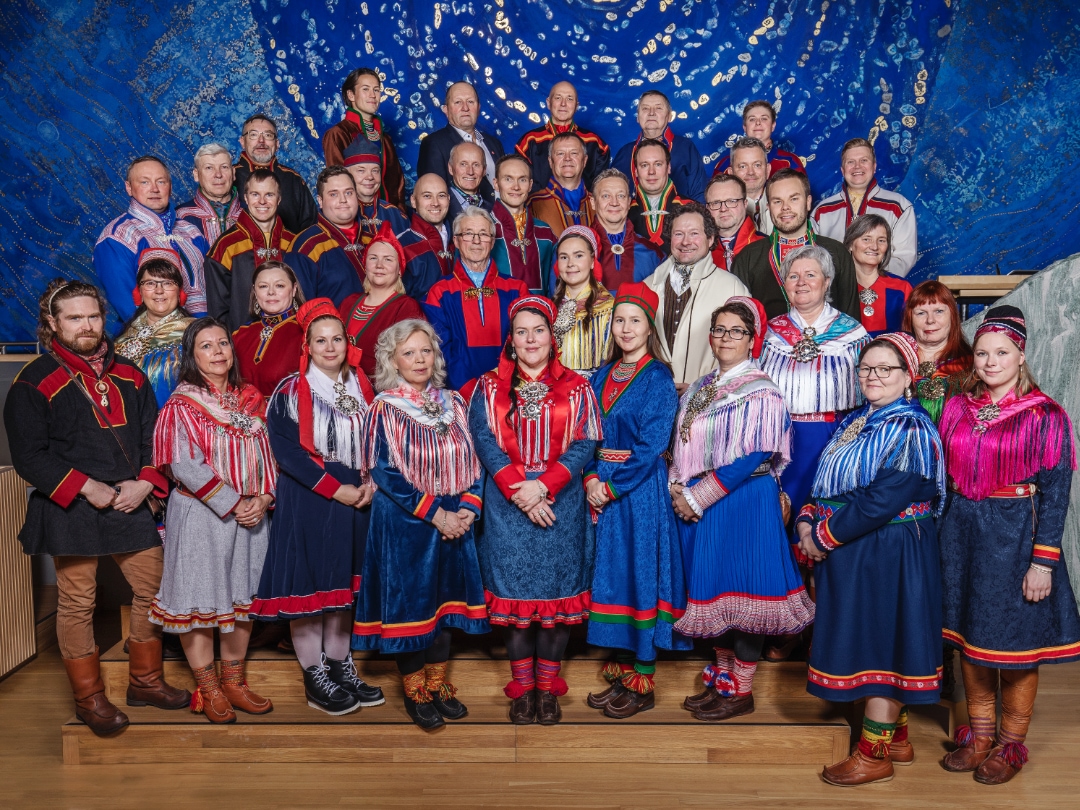
The Sámi Parliament’s representatives for the 2021–2025 term function as a deliberative assembly, with discussions, a partly self-established agenda, and legally delegated responsibility for implementation. Photo: Sámi Parliament.
The Sámi Parliament functions as a form of deliberative democracy in Norway. Through the Sámi Act, the Sámi Parliament has been delegated authority to manage appropriations for Sámi purposes. This is also an arena for discussion and cooperation between elected representatives of the Sámi population, other political institutions, and interest groups. The deliberative institution may, on its own initiative, submit matters to public authorities and private institutions.
Publisert: 18. Oct 2024 Revidert: 15. Mar 2026
The Sámi Parliament is a representative assembly. Many of its decision-making processes are also characterized by broad involvement from Sámi organizations and interest groups. Sámi Parliament representatives often have to negotiate and deliberate with both internal actors and the Norwegian state. This dialogue is, in practice, a deliberative process in which the actors engage in discussion and make decisions based on differing perspectives and needs.
Read also: How can direct, deliberative, and representative democracy interact?
Deliberative processes in the Sámi Parliament
The Sámi Parliament plays an important role in considering and promoting Sámi rights, particularly in matters relating to land rights, culture, and language. Through such discussions, conditions are created for representatives to express and convey the needs of their constituents, while ensuring that decisions are well considered and rooted in Sámi self-determination. This can be linked to deliberative ideals, in which all voices should be heard before a decision is made.
The Sámi Parliament’s dialogue with national authorities is also an expression of deliberative democracy. In this context, the Sámi Parliament participates in discussions with the government to shape policies affecting Sámi rights and interests. Processes such as hearings, consultations, and negotiations with the state can be regarded as deliberative, as they seek to achieve mutual understanding and sound political solutions through open debate and negotiation.
Sámi decision-making processes resembling a deliberative model
The Sámi Parliament also has a cultural dimension that gives it a deliberative character. Traditional Sámi decision-making processes are based on community, dialogue, and consensus, which aligns well with deliberative democracy.
Section 2–1 of the Sámi Act regulates the Sámi Parliament’s area of responsibility and authority, and illustrates in plain terms how the responsibilities of a deliberative assembly can be defined.
Read also: Changes of government create no real change
The Sámi Parliament’s area of responsibility is nothing less than “all matters which, in the opinion of the Parliament, particularly affect the Sámi people.” The Sámi Parliament may raise and issue statements on all matters within its area of responsibility and may submit matters to public authorities and private institutions without having first received a request. The deliberative institution may also administer appropriations for Sámi purposes allocated through the national budget, and may itself issue regulations on the allocation and use of grants.
Decision-making authority delegated by law
Not least, the Sámi Parliament has decision-making authority where this follows from other provisions of the Act or is otherwise determined.
It further follows from Section 2–2 of the Sámi Act that other public bodies should give the Sámi Parliament an opportunity to express its views before making decisions in matters falling within the Sámi Parliament’s area of responsibility.
De fleste av artiklene på Oagal er utarbeidet av redaksjonen. Innholdet fra redaksjonen er det fortløpende redaksjonelle arbeidet i Oagal. Redaksjonen driver undersøkende journalistikk, utvikler ideer til saker og utarbeider artikler ved hjelp av ulike tilgjengelige kilder og verktøy. Meningsbærende innhold og også reportasjer bærer skribentens navn.


0 Comments