Socrates warned against democracy. His critique is often used to discredit popular rule – but in reality it points to the need for better, not less, democracy.
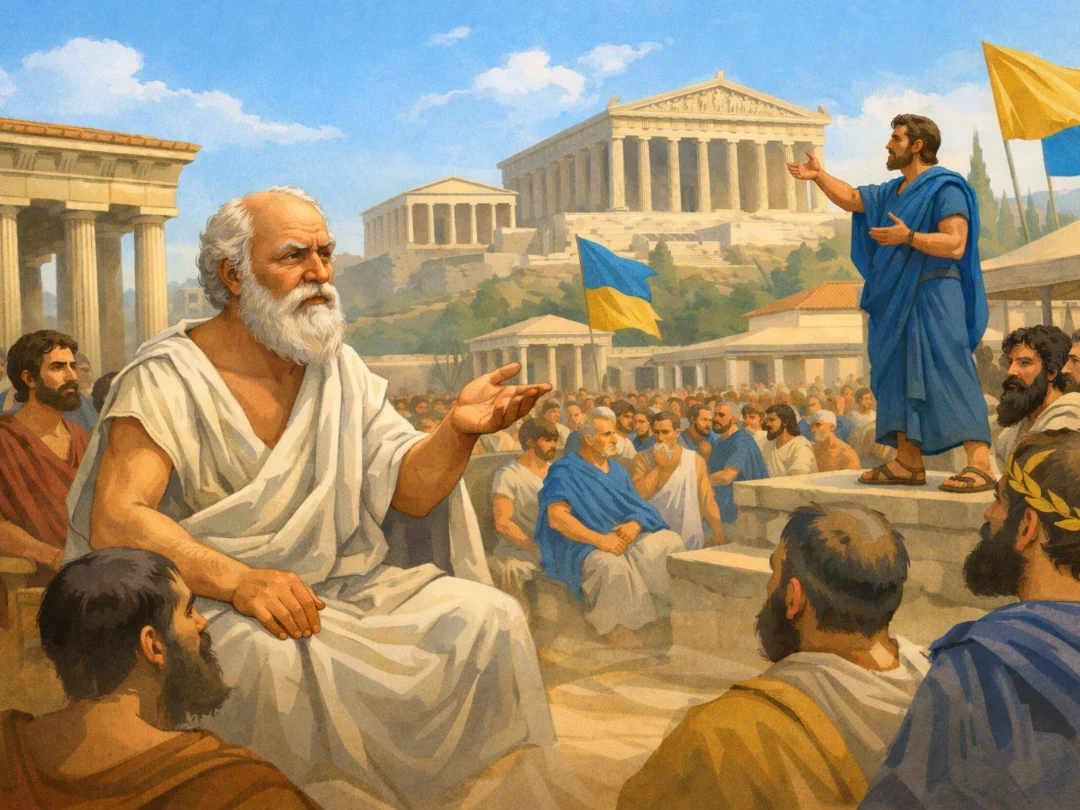
Socrates argued that one informed vote should carry more weight than many uninformed ones, and that people are easily swayed by rhetoric. This critique is often invoked as an argument against democracy. Oagal argues the opposite: Socrates’ critique is not an attack on popular rule, but on decision-making without knowledge, reflection, and real corrigibility.
Publisert: 29. Jan 2026 Revidert: 15. Mar 2026
Democracy is not a static ideal, but a system of governance that must evolve over time. Precisely for that reason, criticism is essential.
The problem arises when criticism of democracy is used to justify less democracy—less participation, less transparency, and less corrigibility. Historically, this has more often led to the concentration of power than to better governance.
Read also: The Oagal model for strengthening Norwegian democracy
A mature democracy must be able to withstand criticism without responding with elitism. The function of criticism is not to discredit popular rule, but to improve how it works.
Socrates’ critique in context
Socrates’ views on democracy are primarily known through Plato’s dialogues, especially The Republic (Politeia).
There, democracy is described as a system in which all opinions are given equal weight, regardless of knowledge, and where decisions easily become the result of persuasion rather than insight.
The most well-known illustration is the ship metaphor: a ship cannot be safely steered if navigational knowledge is dismissed and the helm is handed to whoever shouts the loudest. The point is not that the crew is unworthy, but that governance without competence and responsibility is dangerous.
Socrates’ critique thus targets the quality of decision-making and responsibility, not human equality or citizens’ right to participate.
What Socrates was actually right about
Socrates points to real risks that modern democracies must also contend with:
- decisions can be made without sufficient knowledge
- majorities can be swept up by rhetoric and moods
- power can be exercised without responsibility for consequences
- demagogues can prevail in the absence of reflection and correction
The issues Socrates identified remain highly relevant in today’s media landscape and political reality.
What Socrates could not foresee
Socrates lived in a city-state democracy without modern institutions. He could not foresee:
- universal education as we know it today
- deliberative processes and citizens’ assemblies
- institutional separation of legislative, executive, and judicial power
- independent courts and a professional public administration
His alternative to democracy was rule by philosopher-kings—an elitist system without built-in mechanisms for correction. This is where Socrates’ solution fails.
Oagal’s response to Socrates’ critique
Oagal shares Socrates’ concern about decisions without knowledge, rhetoric without responsibility, and power without correction. But the solution is not to reduce the role of the people. In the view of the editorial board, the answer lies in better democratic processes:
- deliberative assemblies that ensure informed decisions
- a clear link between decisions and responsibility for implementation
- real corrigibility over time
- strengthened power balance and independent oversight mechanisms
Democracy is not improved by making the people less relevant, as Parliament has done by introducing a closed party-list electoral system, but by making decision-making processes more informed, responsible, and corrigible.
Criticism as a democratic strength
Socrates’ critique is therefore not an argument against democracy, but an argument for taking democracy seriously.
A system of popular rule that cannot tolerate criticism is already in trouble.
A system that uses criticism to improve its institutions stands stronger.
Socrates was right in his diagnosis of poor decision-making, but wrong in his cure. Today we have the opportunity to unite popular rule with knowledge, reflection, and responsibility—without giving up democracy’s core.
In other words, what is needed is not less democracy, but better democracy. The work to achieve this will—and should—never be finished in a changing world with shifting circumstances.
Source: ChatGPT
De fleste av artiklene på Oagal er utarbeidet av redaksjonen. Innholdet fra redaksjonen er det fortløpende redaksjonelle arbeidet i Oagal. Redaksjonen driver undersøkende journalistikk, utvikler ideer til saker og utarbeider artikler ved hjelp av ulike tilgjengelige kilder og verktøy. Meningsbærende innhold og også reportasjer bærer skribentens navn.


0 Comments