Kiribati consists of 32 low-lying atolls and the raised island of Banaba, spread across an enormous area of the Pacific Ocean. The country includes the Gilbert Islands in the west, the Phoenix Islands and the Line Islands far to the east.
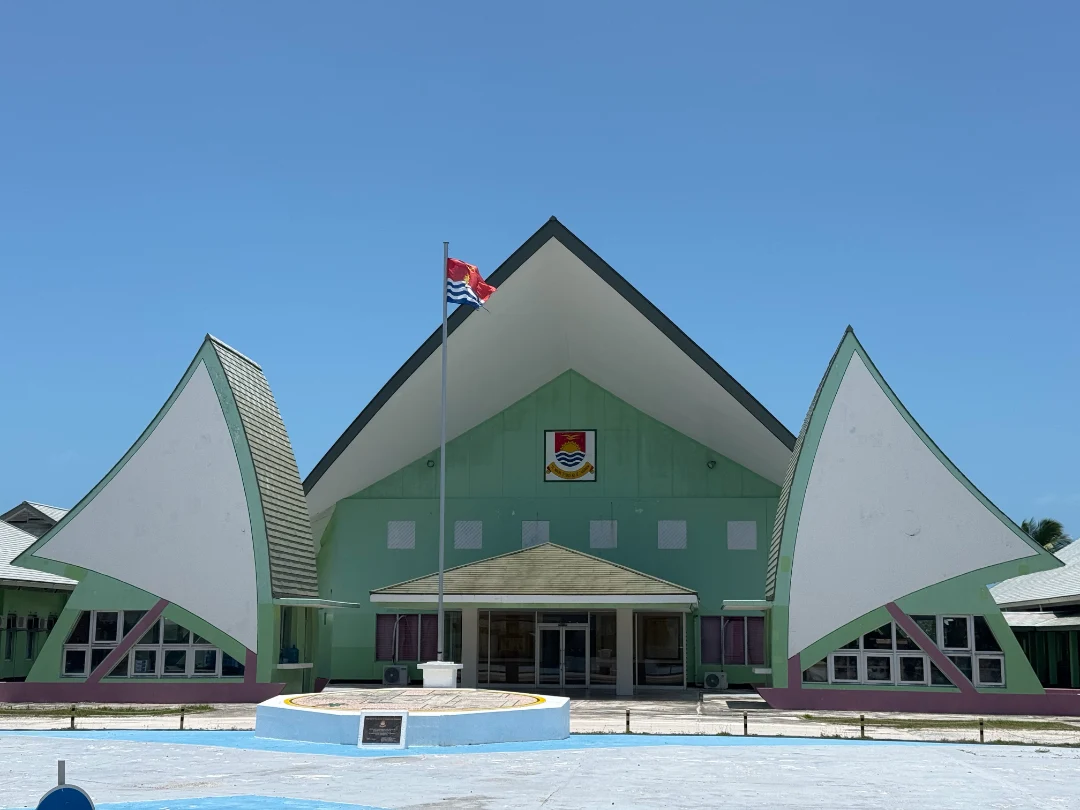
Most of the population lives in the Gilbert Islands. On densely populated South Tarawa, several central parts of the state are distributed among different villages and areas: Parliament is located in Ambo, while Bairiki farther west is home to, among other institutions, the Ministry of Foreign Affairs and several foreign diplomatic missions.
Modern democracy has at the same time acquired a distinctly local expression. The parliament is called Maneaba ni Maungatabu and is based both on Westminster principles and traditional Kiribati values of collective decision-making. It consists of 44 elected members and one special representative of the Banaban community on Rabi Island in Fiji.
Kiribati also combines parliamentary and presidential features. Parliament nominates presidential candidates from among its own members, before voters decide who becomes Te Beretitenti – president and head of government – in a separate national election.
Read also: A terrible year for Norwegian democracy
The Maneaba as a Deliberative Institution
The traditional maneaba is far more than a meeting hall.
It often consists of the characteristic structure visible throughout Kiribati: a large roof supported by pillars, with open sides that allow air to flow through the building. Meetings, ceremonies, celebrations, bingo and other activities in the local community take place here.
But the maneaba also has a political and deliberative history. Kiribati’s parliament itself describes the traditional maneaba as a central meeting house for village deliberation, decision-making and community life, and highlights dialogue, consensus and collective governance as part of the tradition.
Traditionally, the male elders – unimwane – have constituted the village council and played a central role in decision-making. The Pacific Community describes the unimwane as the village’s decision-making body. Within the maneaba system, elders and other local actors meet to discuss issues, give advice and make decisions.
This gives Kiribati a clear deliberative council tradition. The aim has traditionally not necessarily been to divide the assembly into a majority and a minority, but to deliberate toward a solution that the local community can unite around. Kiribati’s own parliament highlights dialogue, consensus and collective governance as central features of the maneaba tradition.
The aim has traditionally not necessarily been to divide the assembly into a majority and a minority, but to deliberate toward a solution that the local community can unite around.
On Kiribati’s deliberative council tradition
The maneaba can therefore be described as a deliberative social institution: discussion is not merely something that takes place before a decision, but an important part of how the decision itself is reached.
The Tradition Is Not Necessarily Egalitarian
This does not mean that the traditional system should be presented as a democratic ideal.
Male elders have historically held strong authority in both the family and the local community, and women have had a more limited place in the formal decision-making process. At the same time, participation in the maneaba has evolved, and modern local communities may involve women, younger people, politicians, professionals and church leaders, among others.
What is democratically interesting is therefore not that Kiribati has preserved an unchanged ancient democratic model, but that a traditional deliberative form of meeting still exists and has at the same time influenced the modern state.
This is most clearly visible in Ambo: Kiribati’s national assembly is located in a modern parliamentary complex on South Tarawa that parliament itself describes as built in the spirit of the traditional Kiribati maneaba.
High Democratic Rating in a Differently Organized Society
Kiribati’s social organization differs from the European model in several respects, but international assessments give the country a relatively high democracy score.
Freedom House classifies Kiribati as “Free” and gives the country 89 out of 100 points in Freedom in the World 2026. The organization describes Kiribati as a multiparty democracy with regular elections and peaceful transfers of power between competing political groups.
At the same time, Freedom House points to problems including pressure on judicial independence, certain forms of gender discrimination and restrictions on personal freedoms.
The high assessment is interesting because Kiribati’s democracy does not consist only of institutions imported from former British colonial rule. Traditional forms of local deliberation exist alongside parliament, elections, courts and government.
Different Democratic Solutions in Kiribati and the Marshall Islands – Societies in Geographic Micronesia
Kiribati and the Marshall Islands are both considered part of the geographic and cultural region of Micronesia in the Pacific.
Micronesia is also part of the name of the independent state Federated States of Micronesia, but neither Kiribati nor the Marshall Islands belongs to that state. They are independent countries within the much larger geographic region of Micronesia.
The Gilbert Islands belong to Kiribati, not the Marshall Islands. At the same time, it is natural to compare the two countries because both I-Kiribati and Marshallese belong to the low-island cultures of Micronesia and over centuries have developed societies on coral atolls with very limited land areas.
Kiribati is also not culturally Polynesian, although historical connections with Tonga, Samoa and Fiji, among others, have added Polynesian and Melanesian elements to a fundamentally Micronesian culture.
The traditional power structures are nevertheless different. In the Marshall Islands, land rights and traditional rank largely follow the maternal line, and the Council of Iroij gives traditional chiefs a separate constitutional role. Kiribati has traditionally had much stronger patriarchal features, with male elders occupying a central place in the maneaba.
Kiribati has also not established a separate national council of chiefs alongside parliament. Instead, the traditional meeting form itself has shaped the national assembly.
The Churches Are a Visible Part of Local Community Life
Religion’s strong physical presence in Kiribati is also reflected in the statistics.
The 2020 census recorded a religious affiliation for more than 99 percent of the population. The Catholic Church was the largest with 58.9 percent, the Kiribati Uniting Church had 21.2 percent and the Kiribati Protestant Church 8.4 percent.
Religious communities also function as more than places of worship. Kiribati’s Census Atlas describes how church organizations operate schools, preschools, youth activities and other community programs, and how religious communities are increasingly building their own maneaba, particularly on South Tarawa.
There is therefore a real overlap between maneaba culture and the social activities of religious communities. The sources do not, however, provide a basis for concluding that the churches generally compete with the traditional maneaba for political control of local communities.
The Church of Jesus Christ Is Growing and Building Beside Parliament
The Church of Jesus Christ of Latter-day Saints illustrates particularly clearly how the religious landscape is changing.
The official census shows that the share of people who identified the Church of Jesus Christ of Latter-day Saints as their religious affiliation increased from 1.6 percent in 1990 to 5.6 percent in 2020.
The church’s own membership records show an even larger presence, but measure something different from the census. At the end of 2025, the church reported 23,585 registered members across 45 congregations and four stakes in Kiribati. It is therefore important to distinguish between registered church membership and the number of people who identify with the religion in a census.
The expansion is also physically visible in Ambo. In 2026, the Church of Jesus Christ is building Kiribati’s first temple on South Tarawa, directly beside the parliament building in Ambo. The groundbreaking ceremony took place in November 2024, and by early 2026 the modular building sections had been put in place.
The location makes the contrast particularly visible: Kiribati’s modern parliament, inspired by the traditional maneaba, is getting a large new religious building as its nearest neighbor directly across the road on the narrow atoll.
Bairiki Brings Together Australia, New Zealand and China
Farther west on South Tarawa lies Bairiki, another of the central areas of the country’s state administration.
Kiribati’s Ministry of Foreign Affairs is located here. Bairiki is also home to Australia’s High Commission in Kiribati, New Zealand’s High Commission in Kiribati and the Embassy of the People’s Republic of China in Kiribati. Kiribati’s Ministry of Foreign Affairs also lists Japan among the countries with a permanent diplomatic presence.
Australia and New Zealand have long-standing ties with the country, while China established diplomatic relations with the current Kiribati government after Kiribati switched diplomatic recognition from Taiwan to Beijing in 2019.
The United States, by contrast, has no embassy in Kiribati. US authorities continue to handle Kiribati through the US Embassy in Suva, Fiji.
This is geographically remarkable because the United States and Kiribati are in fact maritime neighbors.
Kiribati stretches far east to the Line Islands, where Kiritimati – Christmas Island – lies considerably closer to Hawaii than South Tarawa. The formal boundary with the United States does not, however, run against Hawaii itself, but against US Pacific islands and territories. A treaty that entered into force in 2019 establishes maritime boundaries between Kiribati and the US islands of Baker Island, Jarvis Island, Palmyra Atoll and Kingman Reef.
Kiribati is therefore both a small island society with a living local deliberative tradition and a state that geographically extends into an area where Australia, New Zealand, China and the United States have significant interests. The maneaba, parliament in Ambo, the churches and the diplomats in Bairiki show different layers of the same society – traditional, democratic, religious and geopolitical.
De fleste av artiklene på Oagal er utarbeidet av redaksjonen. Innholdet fra redaksjonen er det fortløpende redaksjonelle arbeidet i Oagal. Redaksjonen driver undersøkende journalistikk, utvikler ideer til saker og utarbeider artikler ved hjelp av ulike tilgjengelige kilder og verktøy. Meningsbærende innhold og også reportasjer bærer skribentens navn.


0 Comments