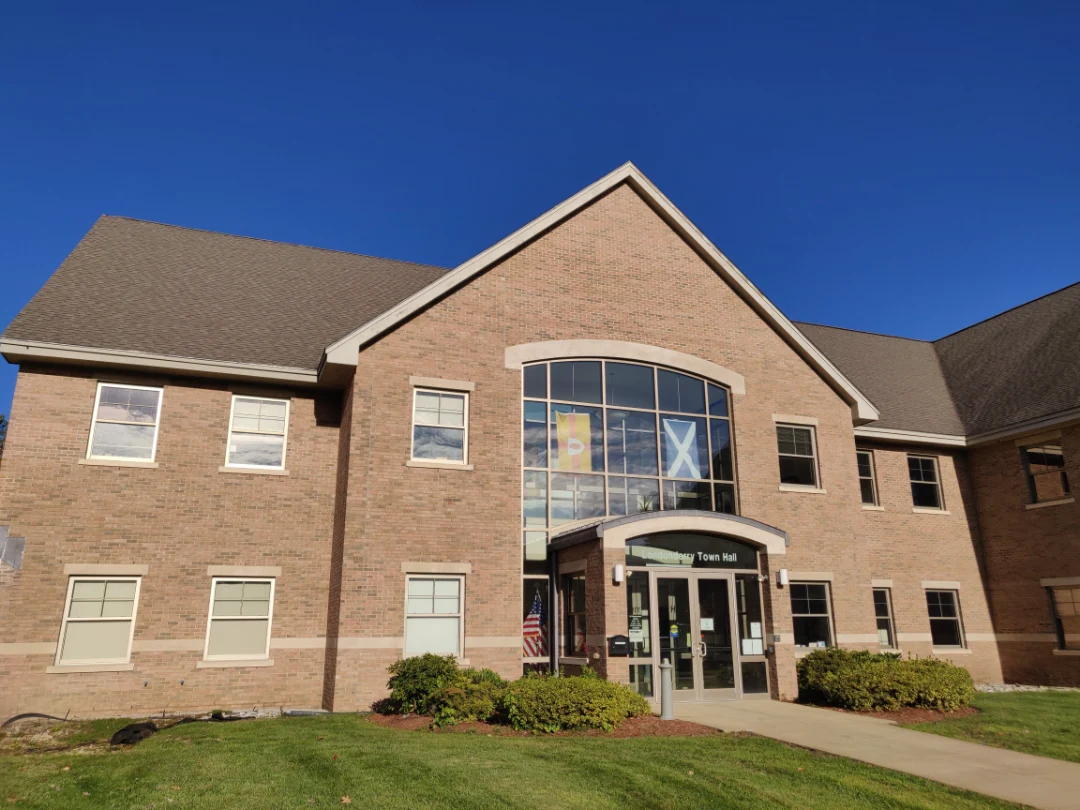
New Hampshire, including places such as Londonderry, has strong deliberative processes. Strong direct democracy is an often overlooked aspect of the USA. Photo: Wikimedia Commons / Jllm06 (CC BY-SA 4.0)
Behind the highly visible federal politics of the USA lies another democratic reality, with strong roots in direct democracy that are rarely visible in the national picture. In New Hampshire, most municipalities still operate under the traditional town meeting–select board model. Town meetings are the municipality's legislative body: Residents do not merely elect representatives – they meet themselves through deliberative processes, including discussions, and make decisions about the municipality.
Oagal observes a development in which many countries, federations and states describe themselves as strong democracies, while an increasing share of ongoing political power in representative systems rests with elected representatives, parties and professional political circles. Representation is necessary in modern democracies, but citizens can also make decisions directly – and leave decisions to representatives when size, complexity or practical considerations make this necessary. Direct-democratic arrangements today play a far smaller role in many representative systems.
In New Hampshire, residents are still lawmakers
The system is described in greater detail by the New Hampshire Municipal Association. Other municipalities in the state have developed a two-stage model.
- Residents meet in a deliberative assembly where proposals are presented, discussed and can be amended.
- The proposals then go to a secret ballot among all voters.
New Hampshire law explicitly describes the first session as a place for presentation, discussion and debate, while the final decision is made by ballot. The arrangement is regulated in New Hampshire RSA 40:13.
Londonderry faced a classic democratic dilemma
Londonderry faced a classic democratic dilemma: At the traditional meeting, a few hundred attendees could discuss and make the final decisions on behalf of the municipality.
A transition to a system of traditional referendums linked to specific issues would give far more people the opportunity to participate in the final decision, but at the same time fewer might take part in the discussion itself. This was explicitly discussed when the municipality considered the change. The Charter Commission discussed precisely this trade-off.
A different and stronger democratic picture of the USA
There are democratic practices here that rarely dominate international coverage of the USA.
The USA contains considerable institutional variation at state and local levels. In 2026, 24 states, Washington D.C. and the US Virgin Islands allow citizen-initiated measures on the ballot. Elsewhere, there are local referendums, recall mechanisms and New England’s old town meetings. The National Conference of State Legislatures provides an overview of citizen initiatives.
The development is not uniform. Democracy in the USA functions differently from state to state and from municipality to municipality. It is therefore more precise to speak of democratic systems in the USA than of a single form of American local democracy.
New Hampshire stands out through its town meeting tradition. The New Hampshire Municipal Association still describes deliberative town meetings as the legislative body in most municipalities, with the power to act on behalf of the municipality where the law does not explicitly assign authority elsewhere.
Londonderry moved decisions to referendums
Londonderry also shows how the system can evolve.
The municipality has a Town Council with five elected members, but the budget and specific proposals go through a separate democratic process. Londonderry’s Town Council consists of five members.
Read also: The citizen proposal system in Norway is misused so that many cases are never considered
Previously, those attending the traditional Saturday meeting made the final decisions. In 2011, Londonderry voted for a new arrangement, by 1,144 votes to 1,044. From 2012, the process was divided into two stages: First comes the deliberative assembly, where residents can explain, discuss and amend proposals. Then all voters decide by secret ballot. The official election result and the change are recorded in Londonderry’s Annual Town Report.
The arrangement remains in place. In 2026, residents took part in a deliberative process in the form of a decision-making debate meeting in the town on February 7. The final vote took place on March 10.
Conducts deliberative budget processes
The municipality’s budget process also allows for public budget workshops, hearings, comments and citizen proposals supported by signatures from residents. A similar system for citizen proposals also exists in Massachusetts.
Read more: Londonderry’s description of the entire budget and participation process
This provides an interesting response to a classic democratic problem: How can discussion, argument and the opportunity to influence a proposal be preserved – without the right to make the final decision being effectively limited to those who have the opportunity to spend an entire Saturday in a meeting room?
Read also: How to submit a citizen petition in Lincoln Massachusetts
The state where the presidential election begins
New Hampshire has a very special place in American national politics. State law requires the presidential primary to be held at least seven days before another state holds a comparable election if necessary to maintain the tradition of the first-in-the-nation presidential primary. This is set out in New Hampshire RSA 653:9.
Much of American presidential politics therefore still begins in New Hampshire, and perhaps one day the state’s local deliberative direct-democratic tradition may also gain greater importance in areas such as analysis, budgeting and the decisions themselves.
Read also: No to a Death Star in the USA, but yes to citizen proposals
De fleste av artiklene på Oagal er utarbeidet av redaksjonen. Innholdet fra redaksjonen er det fortløpende redaksjonelle arbeidet i Oagal. Redaksjonen driver undersøkende journalistikk, utvikler ideer til saker og utarbeider artikler ved hjelp av ulike tilgjengelige kilder og verktøy. Meningsbærende innhold og også reportasjer bærer skribentens navn.


0 Comments