Norway has what Oagal describes as “The Norwegian State’s Triple-Fund Model.” Cash flows from petroleum reserves, the petroleum fund, and the middle class’s residual liquidity and credit capacity through the wealth tax come in addition to revenues from ordinary taxes and duties. These revenues distort the balance between the state and citizens and contribute to an asymmetric democratic model of governance.
Publisert: 11. Feb 2026 Revidert: 15. Mar 2026
Democracy in Norway is challenged by mechanisms described by Oagal in The Norwegian Fund-Backed Political Dominance Model, the fund state. The engine behind this is The Norwegian State’s Triple-Fund Model.
Avoided becoming an oil nation – introduced the disadvantages anyway
The country succeeded in becoming a nation with oil rather than an oil nation associated with accelerating inflation and weakening democracy. However, based on the enormous petroleum fund, the form of governance known as the Norwegian fund state has emerged.
The fund state has parallels to oil nations through its asymmetric political dominance and weakening of popular rule.
Several adverse factors operate in parallel.
- Central to this is that the country for many years has used the “closed list” electoral system, which gives political parties full control over personal selection to the national assembly. The arrangement was reinforced by the new electoral law in the 2025 election. Oagal has conservatively estimated that approximately 2,500 individuals control candidate selection, while the reality is likely closer to 200—and certainly not the approximately 4,000,000 voters. Politicians in the national assembly have at the same time secured a high threshold against entry from competing parties, which in some elections illustrate strong public protest by gathering around 10 percent of the vote.
- Like the other Nordic countries, Norway has no functioning constitutional court. Constitutional matters must proceed through ordinary court processes where decisions diverge across levels and no institution intervenes proactively. Citizens therefore lack constitutional protection against political decisions. The country’s control mechanisms are also controlled by politicians.
- The country has few citizens relative to its geographic size and maintains 3–4 administrative levels. Short-term vote-buying by party leadership has produced an accelerating public administration with record-high costs per capita. Whereas the oil-nation model is associated with the transfer of large sums to a powerful personal elite, in Norway it has done the same for the state itself. The political elite is almost continuously involved in scandals concerning overinvestment in government buildings, the national assembly, representatives’ misuse of housing and travel benefits, and exploitation of other privileges such as limousine services.
Read also: Calls for a new electoral law with a reserve vote
Citizens in Norway have largely accepted the retention of petroleum revenues in the oil fund to counteract short-term negative consequences and safeguard assets for future generations. Petroleum reserves and the petroleum fund generate such substantial cash flows that, in reality, there is no need for the cash flow derived from the middle class’s residual liquidity and credit capacity.
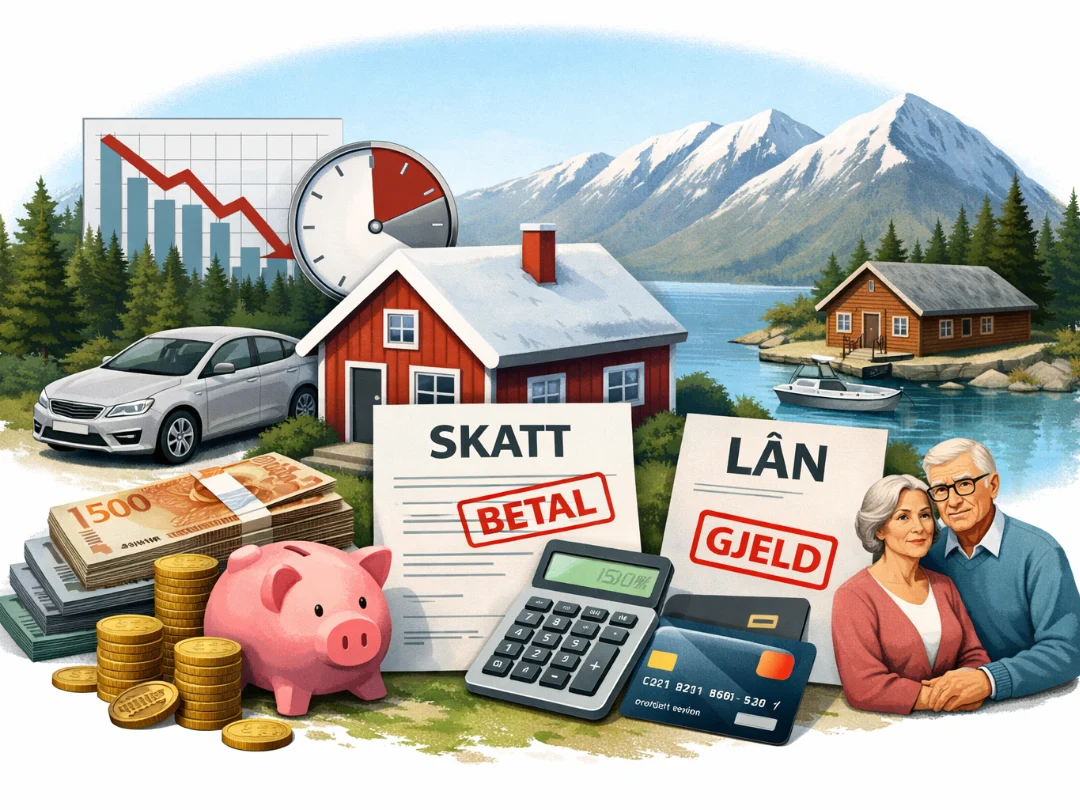
Affects the ethnic Norwegian middle class in urban areas
However, the introduction and tightening of this mechanism are central to the transfer of power within the Norwegian fund state model. In its rhetoric, the political establishment—described by Oagal as an organization-representative system of governance—attacks the 700,000 individuals annually affected by the model as a kind of greedy rich who do not contribute to society.
In reality, these are segments of the Norwegian middle class of ethnic Norwegians, which introduces discriminatory elements. Approximately 40 percent are affected because they own homes in urban areas with high assessed asset values. Historically, the systematic draining of the middle class has led to the gradual decline of democracies.
Read also: Creates a new class divide through the wealth tax
Through what is, as a group, effectively dictatorial power, politicians create polarization in society—made possible only because the state is so wealthy that, in the short term, it does not depend on revenues from the private sector. The political establishment uses the expression “fair redistribution,” signaling “take from the rich and give to the poor,” while in practice much flows to the administration and little is distributed in a Robin Hood–like manner to persuaded voter groups. Voter persuasion also contains elements that allow the practice of envy.
Secures reelection and privileges for politicians
The purchase of voters secures the reelection of this political establishment—including both the right and left—and it is symptomatic that politicians further secured their lucrative positions through the closed list system at a time when the democracy of New Zealand has led the way with a combination of direct candidate voting and party voting under the MMP system.
Powerful politicians appear blinded by the system by acknowledging that private individuals must loan-finance their tax bills, while excluding personal tax capacity and pension savings from the framework of the wealth tax, and rewarding friends and party colleagues with positions in public administration. For example, the country’s ombuds, auditor general, and state administrators who manage the state’s interests in the regions are in practice almost exclusively party colleagues.
At lower levels and within NGOs that are in practice state-financed, systematic political recruitment also occurs, contributing to the politicization of public administration. Through this, the administration becomes less neutral toward citizens and more difficult to steer politically in the event of changes in the composition of elected political assemblies.
De fleste av artiklene på Oagal er utarbeidet av redaksjonen. Innholdet fra redaksjonen er det fortløpende redaksjonelle arbeidet i Oagal. Redaksjonen driver undersøkende journalistikk, utvikler ideer til saker og utarbeider artikler ved hjelp av ulike tilgjengelige kilder og verktøy. Meningsbærende innhold og også reportasjer bærer skribentens navn.


0 Comments