The Solonian Democracy Institute works on democracy beyond elections, with a particular emphasis on digital participation and broader citizen involvement in political decision-making.
Can democracy be understood anew—not primarily as a system of representation, but as real power exercised by the people themselves? The Solonian Democracy Institute starts from precisely this question.
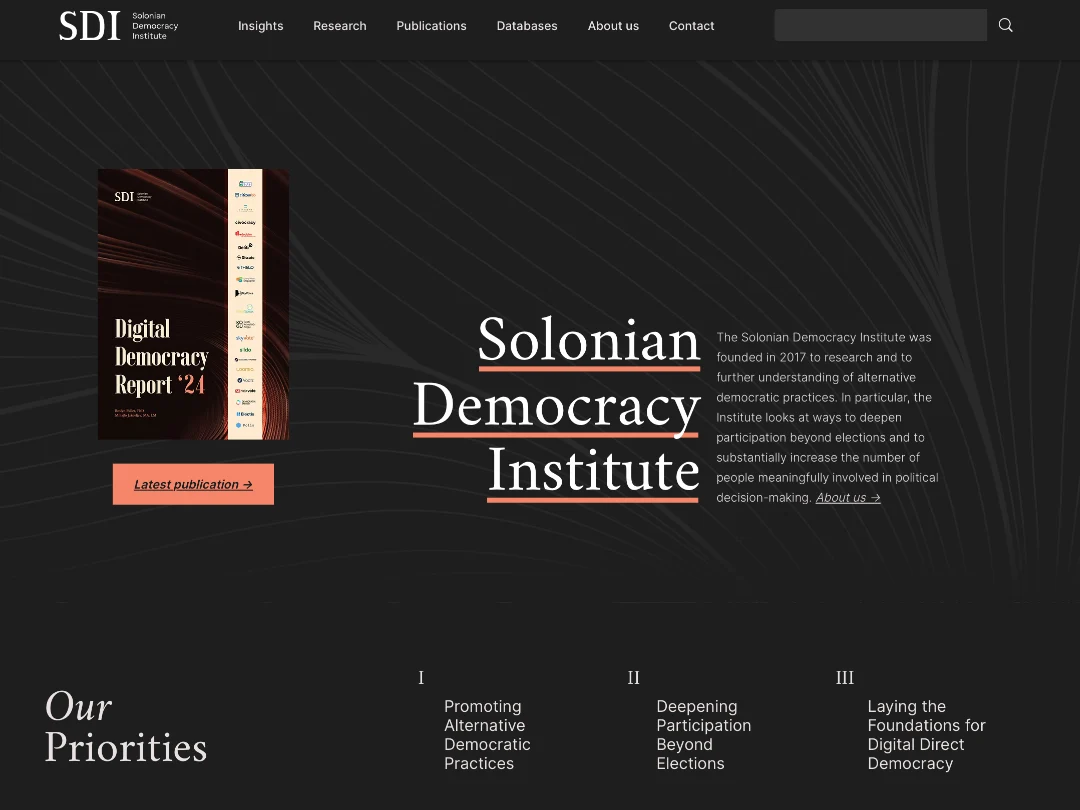
The Solonian Democracy Institute is an independent research and analysis initiative founded in 2017 by Roslyn Fuller and based in Dublin. The institute works to develop and deepen understanding of alternative democratic practices, with particular emphasis on how participation can be expanded far beyond elections.
Learn more: Meet Roslyn Fuller at the Oslo Metropolitan University May 27.
The starting point is simple, but demanding: democracy is understood not primarily as a representative system, but as people power—real power in the hands of citizens.
Read more: Oagal’s corrective perspective on modern democracy
A different starting point for democracy
The institute takes its name from Solon, the statesman who laid the foundations for the development of democracy in ancient Athens. This is not only a historical reference, but also an intellectual position: democracy is understood in light of its original meaning in the Greek term demokratia, composed of demos and kratos.
Where modern democracies are often assessed based on institutional stability and electoral processes, the institute directs attention to something else: how many people actually participate, how decisions are actually shaped, and to what extent power is distributed in practice.
This gives the institute a clear position in relation to much of today’s democracy research, which largely operates within existing institutional frameworks.
Interdisciplinary and international expertise
The institute is organized around a small core and an advisory group with backgrounds in, among other areas, international law, global institutions, economics and governance systems, political theory and democratic innovation, as well as organizational development and leadership.
The contributors have experience from universities, international organizations, and advisory environments, and work at the intersection of theory and practice. Several have also been directly involved in democratic reform processes in different parts of the world.
This combination gives the institute a perspective that is not purely academic, but neither is it activist in any narrow or traditional sense.
Participation beyond elections
At the core of the institute’s work is exploring how more people can participate meaningfully in political decision-making.
This includes, among other things, digital solutions for broad participation, citizens’ assemblies and deliberative processes, the economic and structural conditions for participation, as well as the relationship between democracy and global governance.
The institute also works on interdisciplinary issues that have direct relevance for democracy, including economic inequality and how broader power structures shape democratic practice.
Digital Democracy Report 2026
A central publication from the institute is the Digital Democracy Report 2026 (fifth edition), which appears to be a key flagship work bringing together analyses, interviews, and research related to digital forms of democratic participation.
The report illustrates a central point in the institute’s work: technology does not in itself create democracy, but can—under the right conditions—help expand participation and influence.
At the same time, the work points to important questions related to legitimacy, representativeness, and the balance of power in digital systems.
Independence and methodological approach
The institute describes itself as independent and emphasizes that it does not function as a mouthpiece for external interests. Its work is based on the collection, verification, and analysis of information, with only parts of the material published openly.
This results in a research-based but selective publishing model, where rigor and verifiability appear to be prioritized over volume and visibility.
An interesting point of contact
The Solonian Democracy Institute represents an international perspective that challenges established understandings of democracy—not by rejecting democracy, but by asking more fundamental questions about what democracy is and where political power should actually reside.
For actors working with participation, citizen involvement, and the distribution of power, the institute may therefore serve as a relevant corrective, especially where public discourse largely takes place within the framework of the existing representative system.
De fleste av artiklene på Oagal er utarbeidet av redaksjonen. Innholdet fra redaksjonen er det fortløpende redaksjonelle arbeidet i Oagal. Redaksjonen driver undersøkende journalistikk, utvikler ideer til saker og utarbeider artikler ved hjelp av ulike tilgjengelige kilder og verktøy. Meningsbærende innhold og også reportasjer bærer skribentens navn.


0 Comments