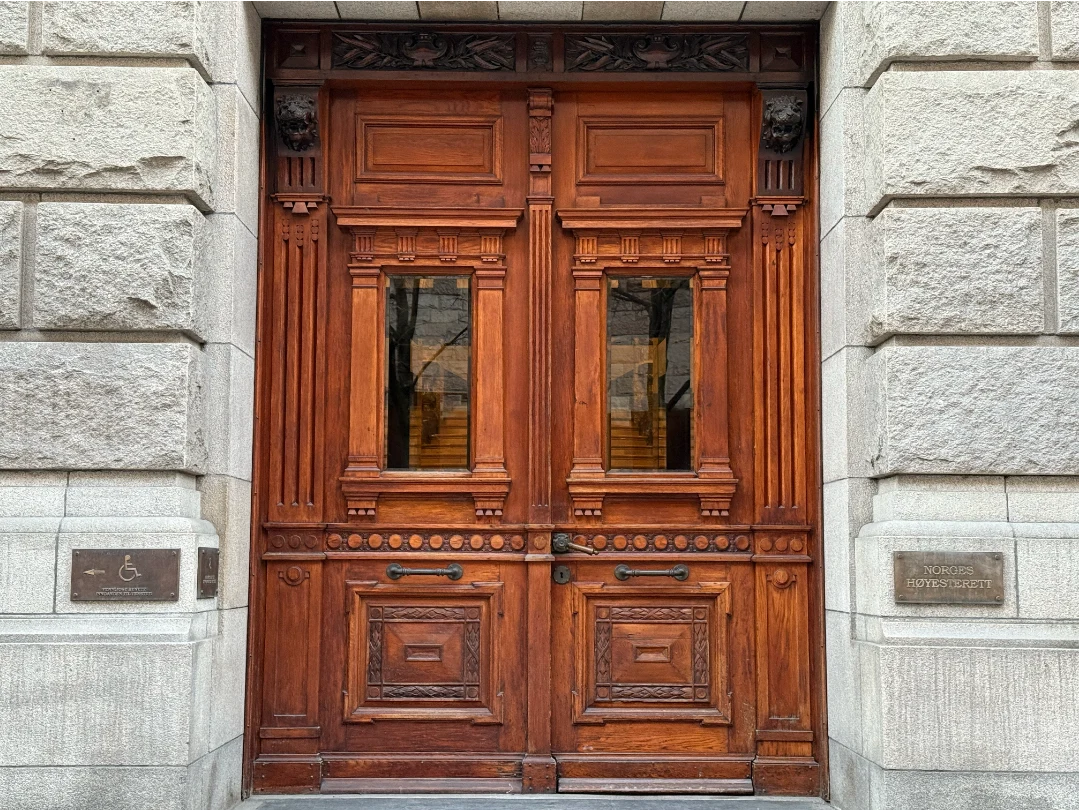
In the unjust state, institutions (here the entrance to the Supreme Court) and individuals participate in seemingly legitimate processes – which can evolve into systematic abuses where “we had no other choice” becomes the explanation in subsequent legal proceedings.
“We had no other choice.” That is often how it is said in retrospect. When systems have committed injustice and people have taken part in something that was clearly wrong, this is the explanation that recurs. In Norway, the unjust state is now gradually becoming more visible, with weakened checks and balances, legal protections, and real influence for the people – while the system still appears legitimate and proper.
Publisert: 15. Feb 2026 Revidert: 15. Mar 2026
In a representative democracy, political power is delegated. It is granted temporarily, on the condition of transparency, oversight, and genuine political competition.
Over time, this power in Norway has become increasingly concentrated in a political stratum that in practice selects itself. Closed party lists, professionalized party structures that only allegedly provide equal opportunities for new members, and high thresholds for new alternatives mean that elections still take place, but within narrow boundaries.
This is a well-known pattern in democratic research and is described as democratic backsliding: gradual democratic erosion driven by legitimate actors within formally democratic institutions. The decisive factor is not that rules are broken, but that they are applied in ways that shift the balance of power. Participants have other choices, but advantages for themselves and their allies become too tempting. Leaders maneuver themselves into even greater power.
Read more: The asymmetrical governance model in the fund state
Cancellation and exclusion as a form of governance
Another characteristic is how political disagreement is handled. Not primarily through open conflict, but through defining who counts as legitimate participants. Actors and voter groups are labeled irresponsible, extreme, or unacceptable – and kept outside real influence even if they enjoy significant support. Oagal regularly returns to this theme, most recently in its description of the Norwegian state’s triple-fund model, which drains the middle class under the guise of fairness.
The result is often cancellation of opinion leaders and concealment of politician-driven political extremism through attacks on both the right and the left. The system appears stable and capable of governing. At the same time, large segments of the population lose the sense of being genuinely heard. When exclusion is framed as responsibility, democratic backsliding becomes difficult to detect while it is happening.
Courts without constitutional counterweight
A rule-of-law state requires more than functioning courts. It requires courts that exercise an independent constitutional role. In the Nordic countries, including Norway, this constitutional court role is weak. Laws can be adopted and have far-reaching consequences without effective, early review of whether they violate fundamental balances of power or civil protections. Courts may end up administering these laws.
They may also participate in developing case law that at times diverges from the statutory text and its preparatory works. In doing so, the courts effectively engage in policymaking contrary to democratic principles and lose their role as a counterweight. In democratic research, this is referred to as autocratic legalism: when the law is applied correctly, but selectively, so that the protective function of the rule of law is gradually hollowed out.
Norwegian public administration marches in step
Norwegian public administration is largely competent, rule-based, and efficient. Precisely for that reason, it is also vulnerable to systemic obedience. Once political directives are given, they are implemented uniformly across the country. There is little room for local discretion, moral friction, or principled resistance.
Here, the absence of local correctives becomes clear. The local sheriff, pastor, mayor, bank manager, or radical voice who speaks out against injustice no longer travels to the capital to argue that something unreasonable has occurred in their town, village, neighborhood, or among their neighbors. No one places unreasonable financial demands into escrow pending clarification.
Instead, everyone acts as part of a large, tightly orchestrated machine. In retrospect, many of those who took part in the march will say: we had no other choice.
Injustice in practice – when reasonableness disappears
A current and democratically highly significant example is the wealth tax, which burdens citizens’ remaining liquidity and credit capacity. The large political industry now strikes relentlessly at approximately 700,000 taxpayers under the pretense that they are some illegitimate “the rich” beneficiary group. In reality, they constitute about 14 percent of the tax-paying population over the age of 17 and have a normal, legitimate basis for their livelihood.
Many of those affected are retirees. In Norway, security in old age has been a cornerstone of the welfare model. When elderly people are financially pressured in ways that may make them dependent on charity and loans to meet the unreasonable demands of state power, something fundamental is undermined. Images from other countries – where elderly couples, neatly dressed, stand at the end of grocery store checkout lines bagging groceries for tips – are not compatible with the Norwegian social ideal.
It is striking that this targeting of part of the middle class does not trigger broad political protest. There is silence from advocates of the vulnerable on the left, and the church does not rise in defense of those made poorer by taxation; no sympathy is extended to those treated unreasonably if they own an expensive home.
A development that can be reversed
Unjust states are evolving and rarely definitive while they are unfolding. They may have passed a tipping point – or be standing just before one. That is precisely why it is crucial to describe the mechanisms while there is still room for action.
Democratic backsliding is not inevitable. It can be slowed and reversed through genuine checks and balances, stronger forms of coparticipation, and popular self-government that is once again experienced as more than a formality. That requires recognizing injustice as injustice – before the explanation becomes that there was no other choice.
De fleste av artiklene på Oagal er utarbeidet av redaksjonen. Innholdet fra redaksjonen er det fortløpende redaksjonelle arbeidet i Oagal. Redaksjonen driver undersøkende journalistikk, utvikler ideer til saker og utarbeider artikler ved hjelp av ulike tilgjengelige kilder og verktøy. Meningsbærende innhold og også reportasjer bærer skribentens navn.


0 Comments